Chapter 5 The quantum substructure
14 minute read
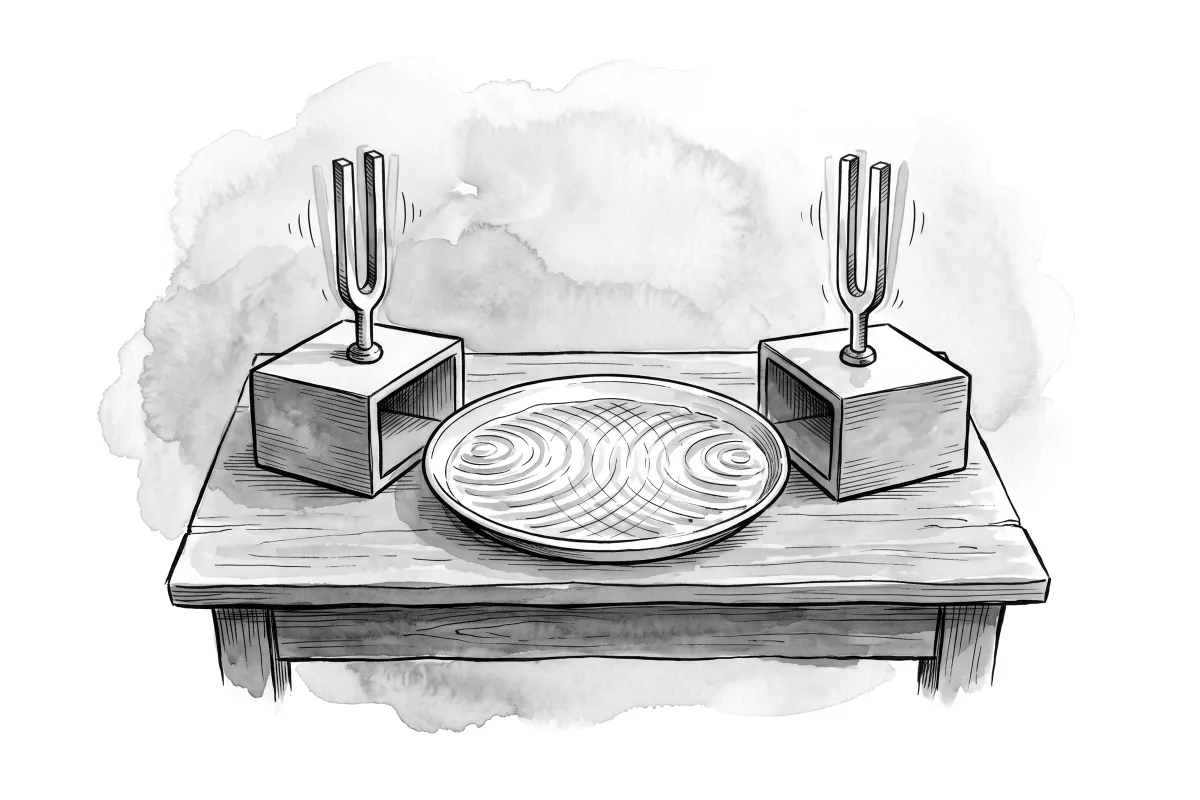
While general relativity governs the large-scale cosmos through smooth curved manifolds, the microscopic world of atoms and radiation obeys a completely different grammar. At the turn of the 20th century, physicists studied glowing ovens, the photoelectric effect, and the discrete spectral lines of hydrogen. They discovered that energy and momentum are not continuous at small scales. Nature at the atomic scale is granular, probabilistic, and woven from complex probability amplitudes.
5.1Quantum states and the uncertainty principle
In classical Newtonian mechanics, the state of a collection of particles at any instant is a single point in a multidimensional phase space. That single point records the exact position and momentum of every particle at once. Knowing that point fixes the value of every physical observable—position, velocity, kinetic energy, and angular momentum—for all future time.
Between 1925 and 1932, Werner Heisenberg, Erwin Schrödinger, Max Born, Paul Dirac, and John von Neumann replaced this classical phase space with a new mathematical architecture. It is built on linear algebra over the complex numbers. Instead of a point in phase space, the state of an isolated quantum system is a normalized state vector in a complex Hilbert space. As we saw in Chapter 2, a Hilbert space carries a complex inner product that measures lengths and angles, and physical state vectors are normalized to unit length.
Because a Hilbert space is a linear vector space, it obeys the principle of quantum superposition. Whenever two state vectors represent physically allowed states of an electron or a photon, any normalized complex linear combination of them is also a valid physical state. In the classical world, a coin is either heads or tails, and a particle passes through either the left slit or the right slit of a barrier. In the quantum world, an unmeasured particle can exist in a coherent superposition of both paths at once. Its complex probability amplitudes then interfere like overlapping water waves, creating bright bands of constructive interference and dark bands of cancellation.
Every physically measurable quantity—energy, momentum, position, or spin—is represented by a linear self-adjoint operator acting on the Hilbert space. By the spectral theorem, the eigenvalues of a self-adjoint operator are real numbers. Those eigenvalues are the only outcomes a laboratory instrument can ever record. Furthermore, the eigenstates corresponding to those eigenvalues form a complete, mutually perpendicular basis of the Hilbert space.
When a physicist measures an observable on a system prepared in a superposition of eigenstates, the detector never registers a blurry average. Instead, the measurement yields a single sharp eigenvalue at random. According to Max Born's rule, the probability of obtaining a specific eigenvalue is the squared magnitude of the projection amplitude, . Across many repeated trials on identically prepared systems, the average outcome matches the expectation value of the operator.
Why can we not measure every observable of a particle at once and pin down its exact position and momentum simultaneously? Because operators, unlike ordinary numbers, do not generally commute when multiplied in different orders. Following Dirac's rule of canonical quantization, the position and momentum operators along the same axis fail to commute by Planck's constant.
In 1929, Howard Percy Robertson proved that this failure to commute forbids simultaneous sharp knowledge of both observables. Applying the Cauchy-Schwarz inequality to any two non-commuting observables yields Heisenberg's uncertainty principle for position and momentum spreads, . The uncertainty principle is not a flaw of clumsy laboratory instruments. It is an intrinsic geometric property of Hilbert space. Localizing a wave packet inside a narrow spatial window requires superposing a broad spread of wavelengths and momenta.
When a quantum system is left undisturbed by measurement, how does its state vector evolve over time? To ensure that total probability remains equal to unity at every instant, time evolution must be a unitary rotation in Hilbert space. By Stone's theorem, any continuous family of unitary time-evolution operators is generated by the self-adjoint Hamiltonian energy operator. Differentiating the evolving state vector with respect to time yields the time-dependent Schrödinger equation:
The strangest feature of quantum mechanics appears when two or more quantum systems interact. When two classical systems are combined, the dimension of their joint phase space is simply the sum of their individual dimensions. When two quantum systems are combined, however, their joint Hilbert space is the tensor product of their individual spaces, so their dimensions multiply. Specifying the exact quantum state of just 300 electrons requires two raised to the 300th power of complex amplitudes, outnumbering all the protons in the observable universe.
Most states in this vast tensor product space are entangled, meaning they cannot be factored into a separate state for the first particle and a separate state for the second. In an entangled Bell singlet pair of electrons, neither electron possesses a definite spin direction of its own. Yet measuring the spin of one electron instantly fixes the correlations of its partner miles away. As John Stewart Bell proved in 1964—and as Alain Aspect, John Clauser, and Anton Zeilinger confirmed experimentally—these quantum correlations violate every inequality of local realism. Nature at its foundation is non-separable.
5.2Feynman path integrals and classical action
If the microscopic world is governed by wavefunctions and superpositions in Hilbert space, how does the deterministic principle of least action of classical mechanics emerge for baseballs and planets?
In 1948, inspired by an earlier remark of Paul Dirac, Richard Feynman answered this question by reformulating quantum mechanics from the ground up. Suppose a particle starts at an initial position at an initial time and arrives at a final position at a later time. Feynman sliced the elapsed time interval into a huge number of tiny time steps and inserted a complete set of intermediate particle positions at every step.
Each sequence of intermediate positions traces out a continuous path through space and time connecting the starting point to the endpoint. Across each tiny time step, the quantum transition amplitude evaluates the kinetic energy minus the potential energy—which is none other than the classical Lagrangian. Multiplying the amplitudes of all the tiny time steps together adds their phase exponents into the classical action integral along the path. Summing over all possible trajectories yields Feynman's path integral formula for the quantum transition amplitude:
In Feynman's formulation, a quantum particle traveling from point A to point B does not choose a single trajectory of least action. Instead, it explores every conceivable path through space and time simultaneously. Wildly zig-zagging paths, looping paths, and straight paths all contribute to the sum with the exact same unit magnitude. They differ only in their complex phase angle, which equals the classical action divided by Planck's constant.
How, then, does a thrown baseball end up following a single smooth Newtonian parabola? For a macroscopic object like a baseball, the classical action is roughly one joule-second, whereas Planck's constant is about a 10-septillionth of a billionth of a joule-second. The phase angle is therefore an astronomical number on the order of 10 decillion radians. Along almost any path where the action is not stationary, nudging the trajectory by even a trillionth of a nanometer changes the phase angle by millions of full revolutions. Neighboring non-classical paths point in completely opposite directions in the complex plane and cancel each other out by destructive interference.
Only one special family of trajectories survives this cancellation: the narrow bundle of paths immediately surrounding the classical trajectory where the first-order variation of the action vanishes. Along that stationary path, adjacent trajectories share almost the exact same phase, so their complex amplitudes line up and reinforce one another by constructive interference. Classical determinism is a macroscopic illusion born from the constructive interference of quantum phases.
5.3Quantum fields and local gauge symmetry
Schrödinger's wave equation and Feynman's single-particle path integral work brilliantly when particles move slowly compared to light. When we combine quantum mechanics with special relativity, however, any theory built on a fixed number of particles breaks down. Why? Because Einstein's equivalence of mass and energy permits pure kinetic energy to convert into matter and antimatter particles. Trapping an electron inside a box smaller than its Compton wavelength injects enough momentum uncertainty to create electron-positron pairs straight out of the vacuum. Furthermore, relativity forbids treating spatial position as an operator while keeping time as a mere label.
The framework that unites quantum mechanics with special relativity is quantum field theory. We demote spatial position from an operator to a continuous spacetime coordinate alongside time, and promote the fields themselves to quantum operators filling all of spacetime. In quantum field theory, elementary particles are not tiny solid spheres flying through a void. Every electron in the universe is an identical quantized excitation of a single universe-spanning electron field. That shared field explains why all electrons everywhere have the exact same mass, charge, and spin.
The dynamics of any relativistic quantum field theory is governed by a Lorentz-invariant Lagrangian density whose spacetime integral is the action. By Emmy Noether's 1918 theorem, every continuous global symmetry of the Lagrangian generates a locally conserved current and a conserved total charge. Time-translation invariance conserves energy, spatial translation and rotation symmetries conserve linear and angular momentum, and global phase rotation symmetry conserves electric charge.
Now comes one of the deepest insights of 20th century physics, pioneered by Hermann Weyl in 1929 and generalized by Chen Ning Yang and Robert Mills in 1954. It is the principle of local gauge invariance, which reveals that all fundamental forces of nature are geometric connections required by local symmetry.
A free relativistic spin-one-half matter particle such as an electron or a quark is described by a four-component Dirac spinor field. Its free Lagrangian is unchanged if we rotate the internal complex phase of the fermion field by the exact same constant unitary transformation at every point in the universe simultaneously. Yet special relativity teaches us that no signal can travel faster than light. Why should an electron in a laboratory on Earth have to synchronize its internal phase convention instantaneously with an electron in the Andromeda galaxy?
To respect relativistic locality, we must demand local gauge invariance. The laws of physics must remain unchanged even when we apply an independent internal symmetry rotation that varies smoothly from point to point across spacetime. When we differentiate a locally rotated fermion field, the product rule acts on both the field and the rotation matrix. That derivative spits out an extra term that ruins the symmetry.
Here an exact structural parallel with Chapter 4 emerges. On a curved spacetime manifold, the ordinary partial derivative of a vector failed to transform as a tensor because the coordinate basis vectors twisted from point to point. Here, in exact parallel, the ordinary derivative of a matter field fails to transform cleanly because our internal symmetry frame twists from point to point across spacetime.
To restore local gauge symmetry, we must replace the ordinary derivative with a gauge covariant derivative by introducing a spin-one vector connection field for each symmetry generator. Inserting this gauge covariant derivative into the Dirac Lagrangian couples matter directly to the force field:
When the gauge connection field transforms under a local phase rotation, its inhomogeneous shift exactly cancels the unwanted derivative of the rotation matrix. Replacing the ordinary derivative with the gauge covariant derivative inside the Dirac Lagrangian automatically generates the interaction between the matter current and the spin-one gauge boson field.
Finally, just as the commutator of two spacetime derivatives gave the Riemann tensor in Chapter 4, the commutator of two gauge covariant derivatives defines the Yang-Mills field strength tensor. For the Abelian phase group of electromagnetism, there is only one generator and the symmetry rotations commute. The electromagnetic field strength is therefore linear, meaning photons carry no electric charge and pass right through one another without self-interacting. For a non-Abelian symmetry group where the generators do not commute, however, the field strength curvature tensor contains quadratic products of the gauge fields. Consequently, non-Abelian force carriers such as the gluons of the strong nuclear force carry color charge themselves and pull directly on one another.
5.4The Standard Model and the Higgs mechanism
Armed with the gauge principle, physicists condensed all non-gravitational forces into a single theory based on the symmetry group . The first factor governs the strong nuclear force of quantum chromodynamics through eight massless gluon fields that bind quarks via three color charges. The second and third factors govern the unified electroweak interaction through four gauge boson fields—three weak isospin fields and one weak hypercharge field.
Alongside these 12 spin-one force carriers sits the matter sector of the Standard Model, arranged into three generations of spin-one-half fermions. The first generation forms all ordinary everyday matter: the up and down quarks inside protons and neutrons, the electron, and the electron neutrino. The second and third generations are heavier, short-lived copies of the first generation produced in cosmic rays and particle accelerators, culminating in the massive top quark. Curiously, the weak nuclear force is chiral, meaning it distinguishes between left-handed particles (whose quantum spin twists counterclockwise along their motion) and right-handed particles. Weak bosons couple exclusively to left-handed fermion doublets and ignore right-handed singlets, breaking mirror symmetry at the subatomic scale.
Yet this chiral gauge structure creates an immediate paradox. In nature, photons and gluons are massless, whereas the weak W and Z bosons are heavier than entire iron atoms, confining the weak force to sub-nuclear distances. Electrons and quarks also possess non-zero rest masses. However, an explicit gauge boson mass term in the Lagrangian directly violates local gauge invariance. An explicit fermion mass term also violates chiral weak symmetry because left-handed fermions are doublets while right-handed fermions are singlets. If the gauge symmetry of the Standard Model Lagrangian is exact, how can any elementary particle have mass?
In 1964, Robert Brout, François Englert, and Peter Higgs solved this mystery through spontaneous symmetry breaking, later woven into the electroweak theory by Steven Weinberg and Abdus Salam. A physical law can possess an exact symmetry even when its lowest-energy vacuum state breaks that symmetry. A pencil balanced vertically on its sharp tip on a table illustrates this mechanism. The law of gravity pulling on the pencil is completely symmetric around the vertical axis, yet the fallen pencil points in one specific horizontal direction.
The Higgs sector introduces a complex scalar doublet field governed by a potential energy curve shaped like the brim of a sombrero. Because the center of the potential curves downward while the outer walls curve upward, a zero Higgs field is an unstable hilltop surrounded by a circular trough of minima. In the fiery first picosecond after the Big Bang, intense thermal energy kept the Higgs field fluctuating symmetrically around zero. All elementary particles raced through space at the speed of light with zero rest mass.
Around 10 picoseconds after the Big Bang, once the expanding cosmos cooled below two quadrillion kelvins, the Higgs field settled into the circular trough. It filled all of space with a uniform vacuum condensate of 246 gigaelectronvolts. As the four electroweak gauge bosons propagate through this Higgs condensate, three combinations drag against it and become the massive W and Z bosons. One orthogonal combination—mixed by the Weinberg electroweak angle—does not couple to the neutral Higgs condensate at all. It remains completely massless as the photon of electromagnetism. Meanwhile, Yukawa couplings to the Higgs condensate give every quark and charged lepton a rest mass proportional to its drag against the background field. Quantized ripples of the condensate itself appear as the 125-gigaelectronvolt Higgs boson discovered at CERN in 2012.
5.5Running couplings and quark confinement
Even after the Higgs mechanism gives quarks and electrons their bare masses, one last surprise awaits when we ask where the everyday mass of our own bodies actually comes from. A proton contains two up quarks and one down quark, while a neutron contains one up quark and two down quarks. Their Higgs-generated Yukawa masses are tiny: about 2.2 megaelectronvolts for an up quark and 4.7 megaelectronvolts for a down quark. Adding three quark masses together accounts for roughly 9 megaelectronvolts—less than 1% of the measured 938.3-megaelectronvolt mass of a proton. Where does the other 99% of the mass of visible matter in the universe come from?
The answer lies in the quantum vacuum fluctuations of the strong nuclear force. In quantum field theory, empty space is never truly empty. It is a boiling sea of virtual particle-antiparticle pairs that wink into and out of existence over fleeting moments allowed by the energy-time uncertainty principle. As Kenneth Wilson explained through the renormalization group, when we probe a charge at different distance or energy scales, these virtual clouds screen or amplify the effective coupling strength.
In quantum electrodynamics, photons carry no electric charge, so only virtual electron-positron pairs surround an electron. Those virtual dipoles align with the electron's field and screen its bare charge at long distances, meaning the electromagnetic coupling grows weaker at large distances and stronger at short distances. In quantum chromodynamics, however, gluons carry color charge themselves. In 1973, David Gross, Frank Wilczek, and David Politzer discovered that virtual gluon self-interaction loops anti-screen color charge, making the Callan-Symanzik beta function strictly negative, .
Because the beta function of the strong force is negative, its coupling strength runs in the exact opposite direction from electromagnetism. At extremely high energies or tiny sub-nuclear distances, the strong coupling constant fades toward zero. Quarks rattling around at close quarters deep inside a proton barely feel one another at all, a property called asymptotic freedom.
Conversely, as two quarks pull apart toward a distance of one femtometer—the size of a proton, corresponding to an infrared scale of 200 megaelectronvolts—the strong coupling grows fiercely intense. Instead of spreading out like an electric field, the self-interacting gluon lines squeeze into a narrow flux tube that pulls with roughly 16 metric tons of force. Quarks and gluons are permanently confined inside color-neutral composite particles such as protons and neutrons, and the energy of their motion and gluon fields generates 99% of our mass. Yet every fundamental equation in relativity and quantum physics runs identically forward and backward in time. Why, then, does the macroscopic universe flow relentlessly from past to future?