Chapter 4 The geometry of causality
14 minute read
4.1From Galileo to Minkowski spacetime
In 1632, Galileo Galilei asked his readers to imagine shutting themselves inside the main cabin below decks on a large sailing ship. So long as the vessel moves smoothly across a calm sea at a steady speed, no mechanical experiment inside can detect its motion. Butterflies fly at the same speed toward every wall, and drops of water fall straight down into a narrow jar on the floor. Five decades later, Isaac Newton built classical mechanics upon this principle of relativity. In Newton's cosmos, space is a rigid three-dimensional Euclidean stage where distances obey the Pythagorean rule. Time is a universal cosmic clock that ticks at the exact same rate for every observer in the universe. When a sailor walks forward along a moving deck, an observer standing on shore simply adds the ship's speed to the sailor's walking speed.
For nearly two centuries, that common-sense picture of space and time seemed beyond question. Then, in the middle of the 19th century, Michael Faraday and James Clerk Maxwell uncovered a deeper layer of nature. Studying how electric charges and magnets push and pull on one another, Faraday proposed that empty space is filled with invisible lines of force. In 1865, Maxwell unified all electrical and magnetic phenomena into a single field theory, later cast by Oliver Heaviside into four coupled differential equations. In empty space free of charges, an oscillating electric field generates a changing magnetic field, which in turn recreates the electric field. The two fields leapfrog through the vacuum as an electromagnetic wave traveling at a fixed speed determined by two laboratory constants of electricity and magnetism.
That calculated wave speed matched the measured speed of light—roughly 300,000 kilometers per second—revealing that light itself is an electromagnetic wave. Yet Maxwell's triumph concealed a profound crisis for Newtonian physics. His equations predicted a single fixed speed of light without specifying which observer measures that speed. If Galileo's rule for adding velocities held true, a traveler racing toward a sunbeam would measure light approaching faster than 300,000 kilometers per second. Most 19th century physicists assumed that Maxwell's equations held true only in one special rest frame, an invisible medium called the luminiferous aether.
In 1887, Albert Michelson and Edward Morley set out to detect the Earth's motion through this aether. Floating a massive sandstone slab on liquid mercury in a Cleveland basement, they split a beam of light along two perpendicular arms. As the Earth orbited the Sun at 30 kilometers per second, light traveling along the motion should have lagged behind light traveling across it. Michelson and Morley rotated their stone table through every angle and repeated the measurement across the seasons. They found no difference at all. Light traveled at the exact same speed in every direction, regardless of how the laboratory moved.
In the spring of 1905, a 26-year-old patent clerk in Bern named Albert Einstein saw the way out of the impasse. Rather than trying to patch up the aether, Einstein discarded it entirely and reexamined the nature of time and space. He elevated two empirical facts into universal postulates. First, the laws of physics take the exact same form in every inertial frame of reference moving at constant velocity. Second, the speed of light in vacuum has the exact same value for every inertial observer, regardless of the motion of the light source.
If the speed of light never changes, then space and time must give way. A simple clock can be built from two parallel mirrors separated by a fixed vertical gap, with a pulse of light bouncing between them. For an observer sitting beside the clock, the pulse travels straight up and down between the mirrors. For a second observer watching the clock glide past horizontally, the light pulse traces a longer diagonal sawtooth path. Because both observers measure the exact same speed of light, the longer diagonal path requires a longer elapsed time on the stationary clock. Moving clocks run slow, moving rulers contract along their line of motion, and simultaneity becomes relative to the observer.
Three years later, in 1908, Einstein's former mathematics professor Hermann Minkowski uncovered the geometric architecture behind Einstein's postulates. Speaking in Cologne, Minkowski declared that space by itself and time by itself were doomed to fade into mere shadows. Only a union of the two would preserve an independent reality. Different observers disagree on the elapsed time between two events, and they disagree on the spatial distance between them. Yet every observer in the universe agrees on a single four-dimensional separation, the Minkowski spacetime interval:
Everything hinges on the single minus sign in front of the time term. In ordinary Euclidean space, all three spatial squares enter with plus signs, so the distance between distinct points is always positive. Because time enters with an opposite sign, the four-dimensional spacetime interval can be negative, zero, or positive. That single minus sign carves the universe at every event into three distinct causal domains.
When the time separation outweighs the spatial distance, the spacetime interval is negative, and physicists call the separation timelike. Massive objects—electrons, planets, and human travelers—always move slower than light, so their trajectories through spacetime, called worldlines, stay strictly inside this timelike region. Along any timelike worldline, the negative interval measures the invariant proper time ticked off by a wristwatch carried along that path. Because curving through space subtracts spatial distance from the time term, a rocket traveler who leaves Earth and returns ages less than a twin at home.
At the boundary where spatial distance balances the distance light travels in the elapsed time, the spacetime interval vanishes altogether. These lightlike intervals trace out a double cone in four dimensions—the past and future light cones of the event. Massless particles such as photons travel along the surface of the light cone, where the elapsed proper time is identically zero. Outside the light cone lies the third domain, where spatial separation exceeds the distance light can travel and the interval is positive. Events separated by a spacelike interval lie beyond each other's causal reach, because no signal can bridge them without outrunning light. Even the time ordering of spacelike-separated events is relative, as different observers see one happen before the other, or both at once.
The linear coordinate transformations that preserve the Minkowski interval form the Lorentz group. Differentiating a particle's spacetime coordinates with respect to its wristwatch time and multiplying by rest mass produces the four-momentum vector. This vector unites energy and three-dimensional momentum into a single four-dimensional arrow. Because the squared Minkowski length of the four-momentum is invariant across all frames, it yields Einstein's energy-momentum relation, . For a particle sitting at rest with zero momentum, this identity reduces to the famous equivalence of mass and energy. Mass is simply concentrated rest energy locked within matter.
4.2Measuring curved geometry
Special relativity united space, time, and electromagnetism, yet it collided directly with Isaac Newton's law of universal gravitation. In Newton's theory, gravity depends only on the instantaneous spatial distance between two bodies. If the Sun were suddenly nudged, its gravitational pull on the Earth would shift at that very instant across 150 million kilometers. Such instantaneous action across a spacelike distance violated the light-cone speed limit of Minkowski spacetime.
The breakthrough began in November 1907, while Einstein sat at his desk in the Bern patent office. He imagined a painter falling freely from the roof of a building and dropping a pocket watch beside him. Because the watch and the painter fall together at the exact same rate, the watch hovers weightless next to the painter's hand. Inside a freely falling cabin, gravity vanishes completely.
Why does every object fall with the exact same acceleration regardless of its weight or composition? In Newtonian physics, inertial mass measures a body's resistance to acceleration, whereas gravitational mass determines how strongly a gravitational field pulls on the body. Experiments show that inertial mass and gravitational mass are equal to better than one part in a quadrillion. Einstein realized that this equality is not an accident, and he elevated it into the equivalence principle.
Inside any small, freely falling reference frame, gravitational acceleration disappears and the laws of physics reduce to special relativity. As we saw in Chapter 2, the curved surface of the Earth looks flat whenever we zoom in on a small neighborhood, even though the whole globe is round. Einstein saw that spacetime works the same way. Locally, inside any small freely falling laboratory, spacetime looks like flat Minkowski space. Globally, gravity is the curvature of the four-dimensional spacetime manifold, governed by a smooth metric tensor field via . We feel weight only when the solid ground pushes upward on our feet to deflect us from our natural freely falling trajectory.
Once the metric tensor varies from place to place, doing calculus on spacetime requires a new geometric tool. On a curved manifold, the tangent spaces at two distinct points are different vector spaces, and the coordinate grid lines twist from point to point. Subtracting vector components at two nearby points mixes real changes in the vector with distortions of the coordinate grid. To compare vectors at nearby points meaningfully, mathematicians introduce a rule for parallel transport called the covariant derivative. It records how the basis vectors turn along each coordinate direction using connection coefficients called the Christoffel symbols.
By the fundamental theorem of Riemannian geometry, any manifold equipped with a metric tensor possesses a unique connection, the Levi-Civita connection, satisfying two natural conditions. First, it is torsion-free, meaning infinitesimal parallelograms close without twisting. Second, it is metric-compatible, meaning the covariant derivative of the metric tensor vanishes everywhere. Metric compatibility ensures that parallel transport preserves vector lengths and angles, so clocks and rulers stay calibrated as they move.
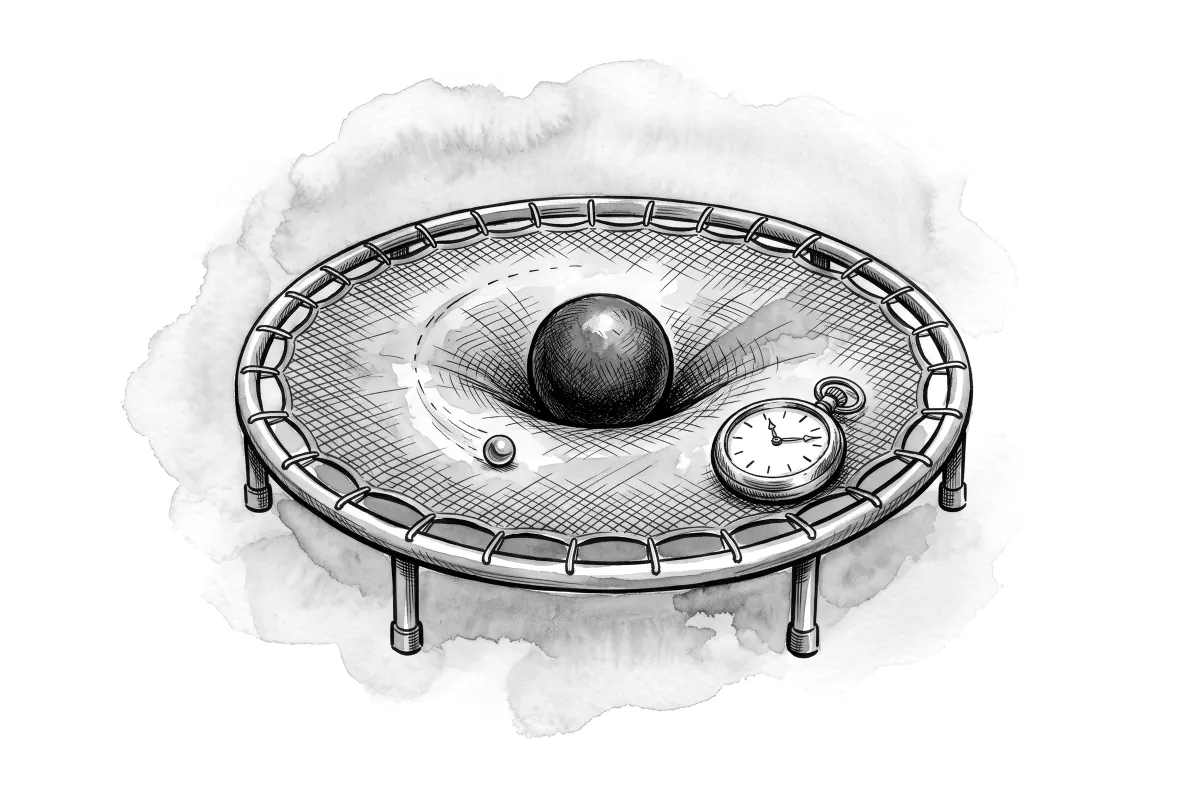
With the Levi-Civita connection in hand, the law of motion for a freely falling body becomes purely geometric. In flat space, a free particle moves in a straight line at constant velocity. In curved spacetime, a freely falling planet, star, or photon follows a geodesic, the straightest possible trajectory on the manifold. A geodesic parallel-transports its own four-velocity tangent vector along itself. The Earth does not orbit the Sun because an invisible tether pulls it across space. Instead, the Sun's mass curves four-dimensional spacetime, and the Earth glides along the straightest path through that geometry.
How can an observer tell true spacetime curvature apart from a wavy coordinate system? Because the Christoffel symbols vanish inside a freely falling elevator, first derivatives of the metric cannot detect curvature at a single point. True curvature appears when we carry a vector around a closed loop or watch tidal forces between nearby falling bodies. Suppose an explorer stands on the equator holding a javelin pointed due north, walks north to the pole, steps onto a meridian 90 degrees east, and returns to the equator. Back at the starting point on the equator, the javelin points due east, rotated by 90 degrees.
Transporting a vector around an infinitesimal closed loop measures the failure of covariant derivatives to commute. On a curved manifold, that commutator defines the four-index Riemann curvature tensor. A spacetime manifold is locally flat if and only if its Riemann curvature tensor vanishes everywhere. Physically, the Riemann tensor governs the relative tidal acceleration between nearby freely falling particles. Summing over two indices of the Riemann tensor yields the Ricci curvature tensor, and contracting once more with the inverse metric gives the Ricci scalar curvature. Furthermore, the contracted Bianchi identity guarantees that the Einstein curvature tensor—built from the Ricci tensor and the Ricci scalar—has zero covariant divergence everywhere.
4.3How matter bends spacetime
By the autumn of 1915, Einstein knew how curved geometry guides matter along geodesics. The great remaining question was the converse law: how do matter, radiation, and energy sculpt the curvature of spacetime?
In Newtonian physics, the gravitational potential obeys Poisson's equation, with mass density alone acting as the source of gravity. In relativity, however, mass density is not independent of the observer's motion. The complete relativistic source of gravity is a symmetric two-index tensor, the stress-energy-momentum tensor. Its time-time component measures total energy density, its mixed components measure momentum and heat flux, and its spatial components measure pressure and shear stress. Local conservation of energy and momentum requires that the covariant divergence of this stress-energy tensor vanish everywhere.
For two exhausting years, Einstein struggled because he initially tried to set the Ricci curvature tensor directly proportional to the stress-energy tensor. That tentative equation failed because the divergence of the Ricci tensor does not vanish unless the scalar curvature is constant everywhere. Finally, in November 1915, Einstein in Berlin and the mathematician David Hilbert in Göttingen converged on the exact field equations of gravity.
Hilbert showed that the entire dynamical law of spacetime curvature flows from the principle of least action. The simplest coordinate-independent geometric scalar is the Ricci scalar curvature, shifted by the cosmological constant. When we make a tiny, smooth ripple in the metric tensor inside a bounded region of spacetime, the total action of gravity and matter must remain stationary. Requiring the action to remain stationary under every possible metric ripple yields the Einstein field equations:
Compactly written on a single line, this tensor equation is a system of 10 coupled, nonlinear partial differential equations for the 10 metric components. On the left sits pure spacetime geometry: the Ricci curvature tensor, the Ricci scalar, the metric tensor, and the cosmological constant. On the right sits the content of the universe: the stress-energy tensor of all matter and radiation, scaled by Newton's constant and the speed of light.
As the physicist John Archibald Wheeler summarized this grand dialogue, matter tells spacetime how to curve, and spacetime tells matter how to move. Because the covariant divergence of the geometric left-hand side vanishes identically by the Bianchi identity, the equations automatically enforce local conservation of energy and momentum. Moreover, why are the equations nonlinear even in empty space where no matter is present? Because gravitational fields and gravitational waves carry energy of their own, and all energy gravitates. Gravity curves spacetime, and that curvature acts as a further source of gravity.
The coupling factor on the right-hand side divides Newton's gravitational constant by the fourth power of the speed of light. Because the fourth power of the speed of light sits in the denominator, spacetime is an elastic medium trillions of times stiffer than steel. It takes the entire mass of the Earth to warp the spacetime metric at its surface by roughly one part in a billion. Yet that slight warping in the flow of time holds our oceans to the ground. Its gravitational blueshift alone makes orbiting navigation clocks tick 45 microseconds faster each day, or 38 microseconds faster after subtracting orbital motion.
4.4Black holes and horizon thermodynamics
Because the Einstein field equations are fiercely nonlinear, Einstein initially doubted that anyone would ever find an exact analytical solution. He was proved wrong less than a month later from the trenches of the First World War.
In December 1915, the astrophysicist Karl Schwarzschild was serving as an artillery lieutenant on the freezing Russian front when Einstein's paper arrived. While calculating artillery trajectories and battling a fatal autoimmune illness that took his life five months later, Schwarzschild solved the vacuum equations exactly outside a spherical mass. By Birkhoff's theorem, this Schwarzschild geometry is the unique spherically symmetric vacuum solution allowed by general relativity. Far from the central body, the geometry smoothly approaches flat Minkowski spacetime and reproduces Newtonian orbits. Closer to a massive star, it predicts the gradual precession of Mercury's orbit and the bending of starlight grazing the Sun, confirmed during the 1919 solar eclipse.
What happens if a dying star exhausts its fuel and collapses until its entire mass is compressed inside the Schwarzschild radius, ? For a star with the mass of our Sun, this critical radius is just under 3 kilometers; for the Earth, it is 9 millimeters. For decades after 1915, physicists thought spacetime broke down at the Schwarzschild radius, where the time metric component vanishes and the radial component blows up.
Yet as David Finkelstein and Martin Kruskal proved in the late 1950s, that apparent blow-up is merely a coordinate mirage, like longitude lines bunching at the North Pole. The true, coordinate-independent tidal curvature of spacetime remains completely finite at the Schwarzschild radius. For a supermassive black hole weighing billions of suns, the tidal forces at the horizon are gentler than those in the room around you right now.
An astronaut falling across the Schwarzschild radius feels no jolt and hits no physical wall. Instead, that radius marks an event horizon—a one-way causal membrane where the future light cones tilt completely inward. Outside the horizon, the time coordinate is timelike and the radial coordinate is spacelike, so a rocket can fly outward at will. The moment an observer crosses inside the event horizon, however, the signs of the time and radial metric components flip. Inside a black hole, the radial coordinate and the time coordinate exchange their causal roles. Moving inward toward smaller radius is no longer moving through a spatial direction; it is moving forward in time. Once inside the horizon, trying to avoid the center is as impossible as trying to avoid tomorrow. Every path inside terminates within a finite proper time at the central singularity, where tidal curvature climbs to infinity and classical geometry breaks down.
In the early 1970s, a surprising bridge to quantum gravity emerged from the study of event horizons. In 1971, Stephen Hawking proved the classical area theorem: in any classical process, the total surface area of all event horizons can never decrease. Noticing the striking parallel with the second law of thermodynamics, Jacob Bekenstein proposed in 1972 that a black hole possesses real physical entropy proportional to its horizon area.
Hawking initially doubted this claim, because anything with energy and entropy must have a non-zero temperature and radiate heat, whereas nothing can escape a classical black hole. In 1974, Hawking set out to refute Bekenstein by calculating how quantum fields behave in the curved spacetime just outside a forming event horizon. To his astonishment, the calculation proved Bekenstein right. Because extreme gravitational redshift near the horizon stretches quantum vacuum fluctuations, a black hole glows like a warm blackbody at the Hawking temperature, .
Integrating the fundamental relation between energy, temperature, and entropy yielded the exact Bekenstein-Hawking entropy of a black hole in terms of its surface area:
This single formula unites in one expression the four foundational constants of nature: Newton's gravitational constant, Einstein's speed of light, Planck's quantum of action, and Boltzmann's constant of thermodynamics. Even more deeply, it shows that the maximum information inside any spatial region scales not with its three-dimensional volume, but with its two-dimensional boundary area. Nature permits at most one quarter of a nat per squared Planck length on the boundary. This holographic bound hints that smooth spacetime itself is woven from microscopic quantum degrees of freedom. We turn now to that quantum substructure.