Chapter 9 The spark of replication
9 minute read
9.1Autocatalytic webs and chemical phase transitions
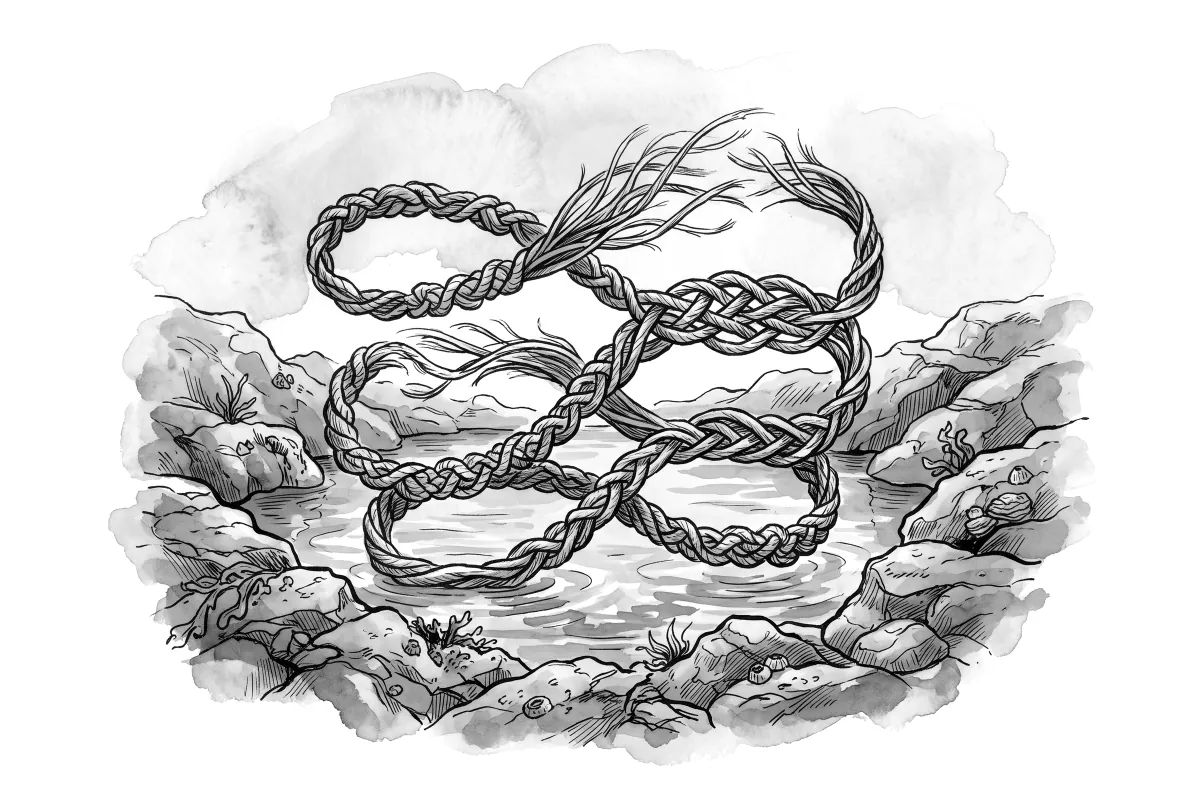
Imagine a rocky shore or a porous seafloor vent four billion years ago, brimming with amino acids, nucleotides, fatty acids, and mineral ions. How does a warm soup of organic chemicals wake up and become alive? To cross the divide separating geochemistry from biology, matter must achieve two intertwined feats. First, it must close itself into a self-sustaining web of reactions that continually rebuilds its own parts from ambient food molecules. Second, it must pass heritable instructions across generations with enough variation for natural selection to act.
For much of the 20th century, skeptics argued that the spontaneous origin of life was statistically impossible. A minimal modern enzyme requires a chain of 100 amino acids chosen from 20 types. The number of possible sequences is , far exceeding the total number of atoms in the observable universe. Waiting for a single self-replicating molecule to assemble by blind luck would take longer than the age of the cosmos.
In 1986, the theoretical biologist Stuart Kauffman showed that this bleak calculation asks the wrong mathematical question. Life did not need to wait for a lone molecule capable of copying itself directly. Instead, self-sustaining chemical networks emerge inevitably as a collective phase transition once a soup of diverse polymers crosses a critical threshold of complexity.
Consider a chemical soup built from a small alphabet of monomer types linked into polymer chains up to a maximum chain length . Summing the geometric series across all chain lengths shows that the total number of distinct polymer species in the vessel grows exponentially. Meanwhile, the ratio of possible cleavage and ligation reactions to polymer species climbs linearly with the maximum chain length, scaling as roughly the maximum length minus two:
Why does the number of reactions grow so much faster than the number of molecules? Any chain of a given length can be formed by joining a one-unit piece to the remainder. It can also be formed from a two-unit piece and the remainder, and so on across every internal junction. As the maximum chain length grows, the number of possible reactions among the polymers outpaces the number of species by a factor proportional to that maximum length.
Suppose that every polymer in the soup has a small fixed probability of weakly catalyzing any given reaction. We can draw this chemical system as a directed network in which nodes represent polymer species and arrows point to the reactions they accelerate.
At first, when the polymers are very short and diversity is small, the expected number of catalyzed reactions per molecule is tiny. By the Erdős-Rényi random graph theorem, when the ratio of catalyzed reactions to molecules sits below one-half, the network consists of sparse, disconnected chains.
As wet-dry cycles or mineral surfaces push the maximum polymer length upward, the ratio of catalyzed reactions to species crosses the percolation threshold of one-half shown above. At that mathematical threshold, the network undergoes a sudden phase transition, much like water freezing into ice. A giant connected component crystallizes inside the reaction graph, forming what Mike Steel and Wim Hordijk formalized as a reflexively autocatalytic and food-generated set.
Inside this collectively autocatalytic web, every molecule in the core set has its synthesis from simple food molecules catalyzed by another member of the set. No single molecule needs to copy itself directly. Instead, the first polymer speeds up the synthesis of the second, the second catalyzes the assembly of the third, and the third closes the loop by catalyzing the first. Long before a precision genetic code existed, statistical mechanics guaranteed that sufficiently diverse polymer mixtures would snap into self-sustaining metabolic closure.
9.2The RNA world and the error catastrophe
A collectively autocatalytic network can maintain and grow its chemical population, yet by itself it lacks digital memory. Without a modular template that can replicate arbitrary sequences, chemical networks struggle to explore open-ended evolutionary possibilities. When we look inside modern cells to see how heredity and catalysis work together, we confront a chicken-and-egg paradox at the core of molecular biology.
In every modern organism, DNA serves as the master blueprint, storing hereditary instructions in sequences of four chemical letters. Yet DNA is a chemically inert archive that cannot copy itself on its own; it requires sophisticated protein enzymes to unzip and replicate its strands. Conversely, protein enzymes perform nearly all the catalytic work of the cell, yet proteins cannot replicate themselves directly. They require DNA, messenger RNA, and the giant molecular machine of the ribosome to specify and assemble their amino acid sequences. How could DNA evolve without proteins to copy it, or proteins evolve without nucleic acids to encode them?
In the late 1960s, Carl Woese, Francis Crick, and Leslie Orgel independently proposed a breathtaking resolution: early life did not divide labor between DNA and protein. Instead, life passed through an RNA world in which RNA performed both jobs at once. Like DNA, an RNA strand stores digital genetic information through complementary Watson-Crick base pairing, matching adenine with uracil and guanine with cytosine. Unlike double-helical DNA, a single-stranded RNA molecule folds back upon itself into intricate three-dimensional pockets and helices. Meanwhile, the reactive two-prime hydroxyl group on every ribose sugar ring acts as a versatile chemical catalyst.
For 15 years, the RNA world remained a conjecture awaiting experimental proof. Then, in 1982, Thomas Cech and Sidney Altman independently discovered ribozymes—natural RNA molecules that cut and splice RNA strands with zero help from proteins.
The ultimate vindication arrived in 2000, when Thomas Steitz, Peter Moore, Venki Ramakrishnan, and Ada Yonath solved the atomic structure of the ribosome. The ribosome is the universal factory that translates genetic code into protein across all life. Biologists expected to find protein enzymes at the heart of the ribosome forging peptide bonds. Instead, the crystal structures revealed a molecular fossil preserved for four billion years. Within 18 angstroms of the active site where every peptide bond is forged, there is not a single amino acid. The catalytic core of the ribosome is pure RNA. Every protein on Earth is built by an ancient ribozyme, while the surrounding ribosomal proteins are structural struts added later.
Even with RNA serving as both gene and enzyme, early life faced a mathematical hurdle discovered by Manfred Eigen in 1971. Suppose an early self-replicating RNA master template replicates faster than its mutant competitors by a fitness superiority factor . Because thermal fluctuations disturb base pairing, each nucleotide is copied with finite per-base accuracy, leaving a small mutation error rate per letter.
For a daughter strand to inherit the entire master sequence without a single typo, every base along its length must be copied correctly. That error-free replication occurs with probability . Writing the mutation-selection rate matrix and average excess productivity for the relative concentrations of competing sequence variants yields Eigen's quasispecies dynamical system and its error threshold:
If the genome length exceeds this maximum threshold, the quasispecies crosses a mutational phase transition analogous to heating a magnet above its Curie temperature. Selection can no longer weed out mutations fast enough, and the master sequence melts away in an error catastrophe.
This threshold exposes a stark catch-22 at the dawn of heredity. Without protein proofreading enzymes, primitive RNA replication suffers an error rate of roughly 0.01, or one mistake per 100 bases. When the natural logarithm of the fitness superiority is near one, the maximum surviving genome length is roughly 100 nucleotides. Yet a ribozyme replicase accurate enough to lower that error rate requires thousands of nucleotides. You cannot maintain a long genome without an accurate enzyme, and you cannot encode an accurate enzyme without a long genome.
Nature escaped Eigen's trap by combining cooperative catalytic loops with cellular compartments. First, as Manfred Eigen and Peter Schuster showed in 1977, several distinct short RNA strands—each under 100 bases—can form a cyclic cooperative loop called a hypercycle. In an open pool, the fastest replicator would drive the rest extinct. In a hypercycle, however, the first strand catalyzes the replication of the second, and the second helps replicate the third. The final strand closes the cyclic loop by replicating the first strand against a shared dilution flux :
Second, as Eörs Szathmáry and László Demeter proved with their stochastic corrector model, enclosing this cooperative team inside a dividing lipid vesicle shifts selection to whole protocells. If a selfish mutant RNA arises inside one vesicle and refuses to help its partners, that protocell grows slowly and loses out to healthy neighbors. Packaging short, cooperative genes inside dividing membranes let early life pool multiple strands and breach the error threshold.
9.3How nature optimized the genetic code
As RNA protocells evolved, those that recruited short amino acid chains gained a decisive advantage. Simple peptides made of glycine, alanine, and aspartate bind catalytic metal ions such as magnesium and stabilize fragile RNA folds. Out of that partnership between RNA and peptides emerged the greatest information breakthrough in Earth's history: the genetic code.
In all living cells today, messenger RNA sequences are read in non-overlapping three-letter words called codons. Transfer RNA adapters and synthetase enzymes translate those codons into chains of 20 canonical L-amino acids. Information theory explains why nature settled on a triplet code. Built from a four-letter alphabet of uracil, cytosine, adenine, and guanine, a one-letter code specifies at most four amino acids, and a two-letter doublet code specifies at most 16. A three-letter triplet code () is the smallest word length capable of encoding 20 amino acids plus start and stop signals.
After Marshall Nirenberg, Har Gobind Khorana, and Robert Holley cracked the 64-codon table in the 1960s, textbooks taught Francis Crick's frozen accident hypothesis. Under that view, the mapping between the 64 triplets and the 20 amino acids was largely a historical fluke. It stayed locked in place only because any later change would scramble every protein in the cell at once.
In 1998, Stephen Freeland and Laurence Hurst put the frozen accident hypothesis to a statistical test. Using a computer, they generated millions of alternative codes by shuffling the 20 amino acids across the 64 codon blocks. For each random code, they calculated the average damage caused when a point mutation or reading slip substitutes one amino acid for another. Their model weighed the fact that transitions between chemically similar bases happen far more often than transversions. It also accounted for the fact that the ribosome misreads the third letter of a codon far more often than the second.
The result was astonishing. Out of one million random codes, only a single code beat the natural genetic code at minimizing mutational damage, corresponding to a probability of one in a million. Far from being a frozen accident, our genetic code is an extraordinary masterpiece of error-correcting design.
That error-correcting logic is visible right in the codon table. At the error-prone third base of each triplet, 30 out of 32 transition pairs are completely silent, specifying the exact same amino acid. Meanwhile, the reliably read middle base of the triplet acts as a switch for water affinity. Every single codon with uracil in the middle encodes a hydrophobic amino acid that buries itself inside a protein's oily core. Conversely, every sense codon with adenine in the middle encodes a hydrophilic or charged amino acid that sits on the wet surface. Even when a mutation changes an amino acid, the replacement nearly always shares the same water affinity and size, preserving the folded protein.
With high-fidelity protein translation running, the stage was set for one final biochemical revolution around four billion years ago. While RNA's reactive two-prime hydroxyl group made it a nimble catalyst, that same group constantly attacked the adjacent backbone, limiting RNA chromosomes to modest lengths. Once protein enzymes took over catalysis, ribonucleotide reductase evolved to pluck that oxygen atom off the ribose ring, creating DNA. At the same time, cells replaced uracil with methylated thymine. Cytosine spontaneously loses an amino group in water to turn into uracil. Using thymine as the standard fourth letter allowed repair enzymes to spot any stray uracil in DNA as damage and restore the original cytosine.
By roughly 3.8 billion years ago, all the core machinery of the Last Universal Common Ancestor—known as LUCA—was humming in unison. Double-stranded DNA held a stable, repairable genetic library of millions of base pairs. Transient RNA transcripts ferried instructions to ribozyme-powered ribosomes. Folded proteins catalyzed thousands of metabolic reactions at lightning speed, and chemiosmotic proton gradients across lipid membranes spun molecular turbines to mint ATP. Out of star-forged atoms and self-organizing chemical networks, the cosmos had kindled a living cellular engine poised to transform an entire planet.