Chapter 17 Energy and the rise of states
9 minute read
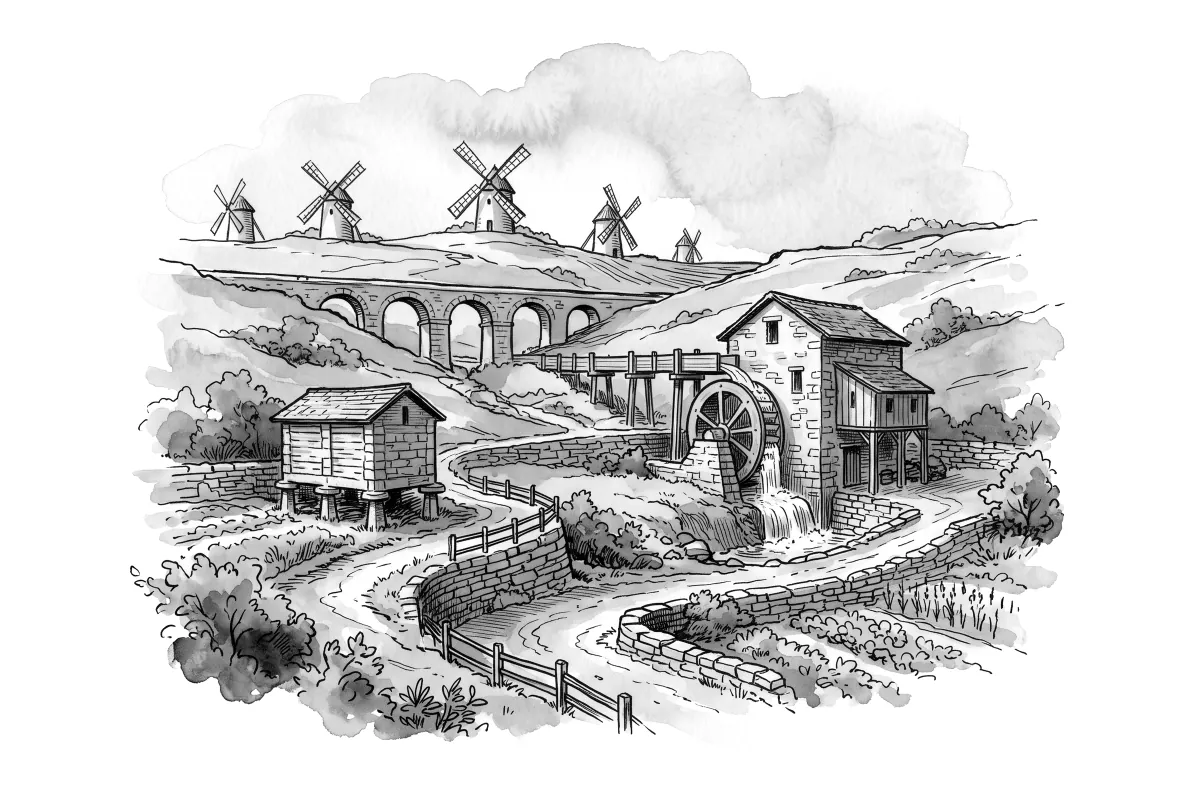
Just as a living cell is a dissipative structure—an open system that maintains internal order by consuming energy—a human civilization is a macroscopic super-organism governed by thermodynamics. Ecology and institutional game theory shape its growth at every scale. Every city wall, law court, road network, and standing army is an island of low-entropy order. Sustaining that order requires a continuous flux of free energy extracted from the biosphere and radiated back as waste heat.
17.1Energy return and the Malthusian trap
For the first 95% of Homo sapiens history, from roughly 300,000 to 10,000 BCE, all humans lived in small, mobile, egalitarian foraging bands. Each band numbered between 30 and 150 individuals, a social horizon set by Robin Dunbar's neocortical scaling limit. Every economy, ancient or modern, stands or falls on its Energy Return on Investment. This ratio measures the usable energy won from nature against the energy spent acquiring it:
Hunter-gatherers harvesting wild tubers, nuts, shellfish, and game achieved a modest energy return of roughly 5 to 1 up to 10 to 1. Aside from campfires for warmth and cooking, they possessed no draft animals or mechanical prime movers beyond human muscle. Consequently, their somatic power output per person was locked to the combined resting basal and active physical metabolic rate of the human body. Each forager ran on roughly 100 watts of continuous metabolic power, equivalent to 2,000 kilocalories of food per day at 4,184 joules per kilocalorie.
When the erratic glacial freezes of the Pleistocene Ice Age gave way to the warm, stable Holocene Epoch 11,700 years ago, that equilibrium broke. Across several independent centers of domestication, human communities began sowing wild grasses and penning herd animals. These centers spanned the Fertile Crescent, the Yangtze and Yellow River valleys, Mesoamerica, the Andes, and New Guinea. Wheat, barley, rice, maize, sheep, goats, and cattle remade the terrestrial biosphere in the Neolithic agricultural revolution.
Skeletal archives from early farming villages reveal a stark biological trade-off. Compared to their hunter-gatherer ancestors, early farmers were several inches shorter and suffered chronic malnutrition and iron-deficiency anemia. They also developed severe dental cavities from starchy gruels and bore the spinal scars of relentless stoop labor. Worse still, living in dense mud-brick villages alongside livestock exposed farmers to a lethal wave of crowd epidemics. Smallpox, measles, tuberculosis, and influenza leaped from herds into human settlements. If early agriculture made individual humans sicker, shorter, and harder-worked, why did it conquer the globe?
The answer lies in areal energy density and Malthusian carrying capacity. A wild forest or savanna locks more than 99.9% of solar net primary productivity inside indigestible wood, bark, and leaves. Because human stomachs can digest only a tiny fraction of wild biomass, foraging landscapes support at most 0.1 to 1 person per square kilometer. By clearing trees and sowing high-yield cereal grasses across alluvial floodplains, farmers raised energy returns to between 15 to 1 and 30 to 1. More importantly, farming multiplied the edible calories harvested per hectare by 10 to 100 times. In the unforgiving arithmetic of territorial war, 10 malnourished peasant conscripts on a square kilometer of wheat always overwhelmed one tall, healthy hunter-gatherer.
To see how this caloric windfall shaped 10 millennia of history, consider the coupled equations of agrarian demography. Let population size and technology level evolve together, with the land's carrying capacity governed by current technology. Throughout the pre-industrial agrarian era, population and technology obeyed the coupled Malthusian-Boserupian differential equations:
The first equation captures the logistic population ceiling formulated by Thomas Malthus and Pierre-François Verhulst. The second captures the insight of Ester Boserup and Michael Kremer that larger populations generate more inventors and faster technological learning. Together, these two equations lock agrarian societies inside the Malthusian trap. Whenever farmers invented a heavier iron plow or dug a deeper irrigation canal, the carrying capacity of the land expanded. For a generation or two, granaries overflowed, famines receded, and infant mortality dropped. Yet families responded to plenty by raising more surviving children. Population grew steadily until it pressed right back up against the new ecological ceiling. Once the land filled up, per-capita caloric income sank back to bare subsistence. From 10,000 BCE to 1750 CE, almost every productivity gain went into supporting larger populations at the edge of hunger rather than enriching the average villager. The sole exception was the concentrated surplus skimmed off the top by a new social machine: the state.
17.2How agrarian states rise and fall
Between 3500 and 3000 BCE, egalitarian villages along the Tigris, Euphrates, Nile, Indus, and Yellow rivers transformed into stratified kingdoms. Palaces, tax registries, standing armies, and monumental tombs rose above the mud-brick huts. Why did states crystallize in those exact landscapes, and why did every agrarian empire eventually fracture and collapse? Three quantitative mechanisms govern the lifecycle of pre-industrial states.
The first mechanism is environmental circumscription paired with the fiscal legibility of cereal grains. The anthropologist Robert Carneiro uncovered the geography of circumscription in 1970, and the political scientist James Scott connected it to crop botany in 2017. Every pristine state on Earth emerged in an arid alluvial river valley hemmed in by deserts, mountains, or steppes. In an open forest or boundless grassland, if an ambitious chief tries to tax a village, the villagers simply walk away into unoccupied territory. Along the narrow green ribbon of the Nile or the lower Mesopotamian plain, walking away meant perishing in the surrounding desert. Productive floodplain soil was sharply circumscribed, caging farmers inside a geographic trap where they had to submit to taxation or starve.
Equally decisive was the botany of the crop itself. No archaic state ever arose on a foundation of root crops such as cassava, yams, taro, or sweet potatoes. Tubers grow hidden underground, ripen across staggered months, can stay buried for up to two years, and rot rapidly once dug up. A king's tax collector cannot easily measure or confiscate a harvest hidden in the soil. Every early state was a cereal grain state built on wheat, barley, millet, rice, or maize. Cereal grasses grow visibly above ground and ripen simultaneously across an entire valley during a single predictable week each year. Once cut and threshed, dry grain is compact, divisible, durable, and easy to weigh. Rulers could march soldiers to the threshing floor on harvest day and seize a fixed fraction of the crop. Stored inside royal granaries, that grain fed scribes, artisans, and standing armies for years.
The second mechanism is the game-theoretic transition from roving raiders to stationary rulers, formalized by the economist Mancur Olson in 1993. Imagine an ungoverned landscape where roving bandits sweep through farming communities and confiscate 100% of the harvest whenever they please. Faced with total plunder, farmers lose all incentive to sow more grain than they can hide. Regional production collapses toward zero in a dismal Nash equilibrium—a mutual stalemate in which no individual gains by changing course alone. Sooner or later, a calculating warlord realizes that he can extract vastly greater wealth over his lifetime by monopolizing violence over a permanent territory. The roving bandit settles down and becomes a stationary bandit: a king.
Instead of stealing 100% of the harvest once and leaving scorched earth behind, the stationary ruler imposes a predictable annual tax share, taking perhaps 30% of each harvest. Because excessive taxation discourages peasant labor while public goods raise productivity, total valley output decreases as the tax rate rises and grows with public infrastructure. Maximizing net royal revenue—tax receipts minus public spending—yields an interior optimal tax rate strictly below 100% and creates two rational incentives. First, the king's troops fiercely protect the peasantry from all other roving raiders. Second, the court invests in levees, canals, roads, and courts until marginal output equals the reciprocal of the optimal tax rate, . Coercive extraction and public order emerged as two sides of a single fiscal bargain.
The third mechanism explains why no agrarian state lasted forever. Throughout history, empires such as Rome, Han China, the Abbasid Caliphate, and the Classic Maya rose in vigor and shone for two or three centuries. Then each descended into fiscal bankruptcy and civil war. Building on the historian Jack Goldstone's work, the quantitative historian Peter Turchin modeled these recurring rises and falls as demographic-structural secular cycles. Three coupled variables drive the cycle: general population, state fiscal health, and the size of the ruling elite.
When a new dynasty unites a realm and restores internal peace, the general population expands steadily across several generations. As rural valleys fill with people, arable land becomes scarce while peasant labor becomes cheap and abundant. Commoners suffer falling real wages and rising rents, a condition Turchin terms popular immiseration. For landowning elites, however, cheap labor and high rents create a golden age of widening estates and lavish consumption. Flush with wealth, aristocratic families raise and educate far more ambitious sons than the general population grows, triggering elite overproduction. Within a century, too many elite aspirants are competing for a fixed number of lucrative state offices, military commands, and tax exemptions. As population approaches carrying capacity and shrinking per-capita tax surpluses cannot cover escalating elite patronage, state fiscal health plunges toward zero. Impoverished peasants and rival noble factions then ignite devastating civil wars on a characteristic 200 to 300 year cycle.
The archaeologist Joseph Tainter identified the deeper thermodynamic ratchet beneath these political crises in his 1988 study of societal collapse. Whenever a complex society confronts an external shock or internal strain, rulers respond by adding a new layer of sociopolitical complexity. They expand the tax bureaucracy, hire more frontier legions, multiply legal regulations, and build costlier infrastructure. Early in an empire's trajectory, solving simple coordination bottlenecks yields a logarithmic gross benefit whose marginal payoff exceeds the unit maintenance cost of each new institution. Yet because the easiest solutions are always tapped first, the net benefit of further organizational complexity is strictly concave and obeys diminishing marginal returns:
Here the linear subtraction term represents the continuous metabolic maintenance cost of each unit of administrative and military apparatus. Because the second derivative of net benefit is strictly negative everywhere, the curve has no inflection point. Instead, net return reaches a unique stationary peak at , where marginal gross benefit equals unit maintenance cost. Once complexity grows past that optimal peak, every new bureau or garrison consumes more energy than it adds in productive capacity. At that point, the state becomes brittle to any harvest failure or fiscal shock. Societal collapse is not a mysterious freak catastrophe. It is an economizing thermodynamic rollback to a simpler, lower-overhead level of organization when an agrarian energy base can no longer afford its imperial superstructure.
How did humanity finally break out of the 10,000-year Malthusian trap and the agrarian collapse ceiling after 1750 CE? The escape required fusing a new energy regime with a new institutional regime. On the thermodynamic side, Britain and then the wider world tapped the subterranean forest of fossil solar energy. Coal, oil, and natural gas—formed from hundreds of millions of years of compressed photosynthetic biomass—delivered initial energy returns of 50 to 1 up to 100 to 1. Coupled to heat engines such as the Watt steam engine, internal combustion turbines, and electric dynamos, fossil fuels liberated production from the annual acreage of living farmland. On the institutional side, as Douglass North, Daron Acemoglu, and James Robinson showed, constitutional checks, property rights, and patent laws redirected elite ambition toward innovation. Within two centuries, human energy use per person surged 25-fold to 100-fold, rising from 100 watts of muscle power to between 2,500 and 10,000 watts. Global population rose to eight billion while human life expectancy more than doubled from 30 years to over 73 years.